Sponsored Link

Showing posts with label Nikon. Show all posts

Friday, October 24, 2008

PhotoPlus Expo 2008 – Day One

Nikon booth

The PhotoPlus Expo opened today in New York City. Hot on the heels of Photokina 2008, PDN’s PhotoPlus Expo brings new cameras, lenses and other goodies introduced in Germany a couple of weeks ago. Greeting visitors at the entrance was Nikon’s rather large booth.

Featuring a complete collection of Nikon’s camerasHalf of a Nikon D3 and lenses, visitors were allowed to mount and test any one they wanted even on their own cameras.

Nikon P6000The Coolpix section featured every model currently available including the P6000 top end point and shoot model. This model features RAW capture and built-in GPS for easy geo-tagging of images.

Also present was a display sampling a cross-section Coolpix bling blingof bling-bling add ons available for the Coolpix lines. This is a prime example of the ubiquity of point and shoot cameras as they have achieved a critical mass that is able to support this kind of secondary market.

Asking around the Nikon booth for any news on the rumored MX platform get me a lot of shifty looks and expressions of discomfort (PR people love to talk incessantly about their products. Restricting them from doing so causes them to go against their basic nature.), leading me to believe there is more than rumor working here.

Mamiya DL28 (Front)Moving over to the Mamiya booth, I got a chance to play with their recently announced DL28 camera system. This system is actually a Mamiya AFD III medium format camera body, a Mamiya 80mm prime lens, and a Leaf Aptus II-6 28 megapixel digital back. The really innovative part of this system is it’s price: $14,999 USD which is a new low for this class of photographic equipment. One of the Mamiya reps told me that at this price point, Mamiya is giving you the camera for free and the digital back at a 33% discount.

Another slick feature of the Leaf back used in the Mamiya DL28 iPhone interfaceDL28 system is the ability to display images wirelessly on an Apple iPhone. The camera has to be tethered to a computer running Leaf Capture software in order to transmit the images wirelessly.

One of the technologies being considered by Mamiya is the use of Wireless USB in the future to allow wireless tethered operation. This, of course, will require the widespread adoption of Wireless USB in order to work, so that’s still a couple of years off.

Epson 3800 printerThe Epson booth had all of their pro printers on display ranging from the highly affordable R1900 to the immense R11880. The R3800 is the only member of the family that has not been upgraded to the Extreme HDR inkset (the one with Vivid Magenta), but I have been told that you can’t really notice the difference. The R3800 is still the only printer in the Pro line that auto-switches between matte and photo blacks.

The R4880 was on display right next to the R3800 and Epson 4880 printerthe size difference is staggering. If you buy one of these beasts, make sure you buy the stand or get yourself a really large, sturdy table. As mentioned before the R4880 has to be manually switched between matte and photo black inks.

Olympus Micro 4/3 prototypeOver at the Olympus booth, the Micro Four Thirds prototype was on display under glass in all it’s retro glory. I’m guessing we’ll see more announcements at PMA 2009

Also on display are all of Olympus’ current offering Olympus E-420including the miniscule E-420. When mated with the 25mm pancake lens, the whole SLR can fit in a pocket.

Leica S2 is the center of attentionLeica had the S2 System on display. For a prototype, it was extremely well made. It is also big. Considering that this is a medium format-ish system this is to be expected. The lenses are spectacular looking to say the least. Since I was not allowed to take any test images yet, they remain a mystery. One big question It's not small...about this system that has not been answered is price. Leica has not stated the price and will not until it is closer to launch (probably in or around PMA 2009).

Adobe draws the crowdsAdobe was drawing in large crowds with the release of Creative Suite 4 (CS4). CS4 is a significant move on Adobe’s part as it migrates them to 64-bit (at least on Windows Vista). The first professional group to take advantage of the 64-bit platform was digital content creation – 3D artists, modellers and animators. The second group is digital photographers. With systems like the Mamiya DL28 (which produces 50 MB RAW files), and the Hasselblad H3DII-31 (sporting 40MB RAW files), both of which are starter systems and list for less than $18,000, digital photographers will need access to large amounts of RAM and the enhanced processing power of 64-bit systems.

Well, that about wraps it up for Day One. Stay tuned for coverage of Day Two.

Saturday, September 6, 2008

Nikon MX Rangefinder musings...

Rumors have been flying about the blogosphere regarding an earthshaking product introduction by Nikon. Nikon took out a half-page ad in Rangefinder Magazine about "Something Big" to be announced at the WPPI convention in February 2009.NikonRumors has been tracking this for quite a while and even Wired picked up on this. So far the rumors have Nikon introducing a new format sensor called MX. The MX sensor is 48 mm x 48 mm and has 40.7 megapixels. These pixels are the same size and pitch as the ones in the D3/D700 so the camera should have spectacular low-light capabilities. The sensor can be masked for portrait or landscaped images without having to rotate the camera. The camera will be able to mount DX and FX lenses with and adapter. Here are some observations and deductions I have made: 1. Nikon wants in on the lucrative MF/Wedding market and will lowball the competition severely. Phase One is currently offering a P45+ back for $29,990 and they are throwing in the rest of the camera kit (Body, Viewfinder, & 80mm Lens - an $11,000 value) for free. Rumors place the price of the MX in the sub $10k range. 2. The RF in this system will likely be a refined version of the ERF in the D700. If the MX uses a optical viewfinder, it may not couple with the focus mechanism (ie, will only be used for framing the image and will always be in focus) while the lens AF handles the actual focusing. If they take the path of EVIL (Electronic Viewfinder Interchangeable Lens), then they can simulate SLR-like framing, focus and composition in an RF style body. 3. It will likely be way smaller than current DMF systems. Especially if they use EVIL. 4. FX lenses will have a .5x magnification crop. Wides will be wider and and teles will be shorter. This will target the Alpa/Cambo/Horseman shooters who are looking for a smaller landscape/architecture rigs. The MX would offer superior features over those systems as they are all scale-focus cameras.


UPDATE: Nikonrumors has posted another update. It looks like the MX (codename "Otoji") will be a mirrorless design. Here is the quote: The initial problem of the difference in flange register between both standards is addressed by the automatic repositioning of the focal plane of the sensor unit. The adjustment is made automatically when the adapter is mounted. The mirrorless design allows for adequate space to accomplish this while electronic masking ensures accuracy while still keeping the unit size very compact. The keywords here are:
  • automatic repositioning of the focal plane of the sensor unit when the adapter is mounted
  • mirrorless design

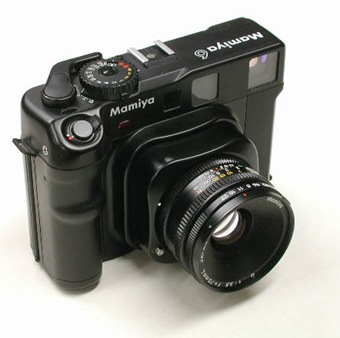
  • UPDATE 2: Matt over at Nikonwatch has received the following anonymous tip: Dear Matt FYI: On speaking with Nikon [in country unnamed], this came to light with various questions - they already had development plans for a new Nikon digital rangefinder with approx 48mmx48mm size sensor inside it, tentatively called the “MX” format, the camera is not to dissimilar to the older film Mamiya 6 camera philosophy. The new camera will be backward compatible with DX and FX lenses (via mount adaptor), therefore the lens factor (based on using a FX lens) will be worked out like this: DX = 1.5x (Half frame) FX = 1.0x (Full frame) MX = 0.5x Custom format choice: When shooting in FX mode with this camera, you will be able to “rotate” the sensor crop from landscape to portrait rather than turn the camera as well as be able to shoot the full square resolution this camera provides. options for 5:4 etc will also be available. Viewfinder/Live View: For more critical cropping (like for still-life and macro work) you will be able to use the live view function for exact framing rather than the rangefinder component. Sensor: about 48 megapixels, similar to the Nikon D3 design. Lenses: New range of lenses required for the full MX format, zoom option available covering different ranges on different formats, lenses relatively compact for format size. Summary A relatively compact traditional “medium format-esque” camera in a new camera line that will be aimed at studio, portrait, landscape and wedding photographers needs, with a more affordable price point than present larger format digital backs. This will allow the continuation of the D line as the sports and news photographers choice, expanding on the D3 with an upgrade to a 24mp sensor (hopefully available for the D3 body!) and future plans for 60 frame rate video recording modes in future models. Please keep my name, email and location anonymous. This certainly fleshes out more details about this rumored camera. But several questions remained unanswered: 012980F0-1D8D-4468-822A-79757FC4B114.jpg How big will this camera be? Medium Format cameras are large and boxy due to their modular nature. Will this system be smaller than current MF offerings or will it be about the size of the old Mamiya 6? This brings up an interesting point: There is another, parallel rumor circulating that the "MX" moniker only means "modular" or "multi-format". So will this be a "classic" rangefinder or MF SLR style body or a mutant mirrorless design? I myself favor the mutant mirrorless version as this would allow Nikon to really shrink the body and still provide such goodies as TTL framing and focusing as well as electronic masking and would cut down on the mechanical complexity of the camera.

    Thursday, August 7, 2008

    Nikon Unveils Coolpix P6000

    P6000 Logo
    NEW COOLPIX P6000 OFFERS DIGITAL SLR SHOOTING CONTROL IN A COMPACT CAMERA New Performance Series Camera Enables Users to Test the Photography World with Creative Control and "Geo-tagging" Capabilities with built-in GPS MELVILLE, NY (Aug. 7, 2008) - Nikon Inc. today introduced its newest flagship COOLPIX compact camera, the COOLPIX P6000. Featuring 13.5 megapixels, a new, built-in global positioning system (GPS) unit, my Picturetown connectivity and the power of Nikon's exclusive EXPEED™ image processing concept, the P6000 offers the perfect photographic tool for photo and camera enthusiasts seeking the creative control of a D-SLR in the compact body of a COOLPIX camera.P6000 Front "We are eager to see the response to the integration of the new capabilities for COOLPIX cameras, as the demands of our consumers are always a priority in product design," said Bill Giordano, general manager marketing, COOLPIX for Nikon Inc. "The P6000 is an exciting product offering for Nikon's COOLPIX line, as it not only provides expanded creative control for photo enthusiasts, but also empowers them with GPS functionality and my Picturetown connectivity." The P6000 knows where the "best shots" are taken, thanks to the integration of the new GPS unit. With the added GPS function, P6000 users will be able to record "geotags" of the location where their images are captured based on latitudinal and longitudinal coordinates. This further heightens the photographic experience, allowing users to pinpoint the location via maps available in Nikon ViewNX Software, my Picturetown, Nikon’s photo sharing and storage website, or any other software or website that recognizes GPS data. Additionally, the P6000 makes my Picturetown connectivity for uploading and sharing photos simple and easy, thanks to added wired LAN support via a dedicated Ethernet port built into the camera. Users can upload their images and data directly from the P6000 with an Ethernet cable to the secure Picture Bank service on my Picturetown. In line with other COOLPIX P-Series cameras, the P6000 includes intuitive controls via dedicated command and mode dials, providing easy access to shooting controls and exposure mode settings. The P6000 offers Programmed Auto [P], Shutter-priority Auto [S], Aperture-priority Auto [A] and Manual [M] modes granting users the ability to tap into the creativity of D-SLR functions while maintaining the simplicity of COOLPIX functionality. Owners can utilize two user-defined settings, a shooting menu, an efficient, tabbed menu interface, as well as customizable Function buttons to quickly switch between camera settings. Additional shooting innovations engineered to maximize image quality and offer greater control over the final results include Nikon’s original COOLPIX Picture Control System and a new NRW* (RAW) support. The COOLPIX Picture Control System features intuitive controls that enable users to adjust their images to pre-set parameters such as Standard, Neutral, Vivid and Monochrome and apply tweaks to image sharpening, tone compensation, brightness, overall tone and saturation. Furthermore, images shot in the all-new NRW* (RAW) format can be opened and viewed in Nikon ViewNX Software (available early October 2008) for increased editing abilities. P6000 w/SB400 & Wide AdapterAdding even more synergy between D-SLR cameras and compact COOLPIX cameras, the P6000 incorporates a pop-up flash, optical viewfinder for easy composition and the added bonus of system expansion with an optional convertor, Speedlights, and wireless remote control. Nikon's new 0.76x Wide-angle Convertor WC-E76 offers users the option to utilize focal lengths as wide as 21mm (35mm format equivalent). P6000 users can also take full advantage of Nikon's Creative Lighting System with the built-in accessory shoe that supports Nikon's i-TTL flash control, which enables wireless control over one group of remote Speedlights including the newly announced SB-900 Speedlight. The P6000 features a quality finish and a front panel constructed of solid Magnesium alloy, as well as a comfortable grip and well-placed controls for streamlined performance. The new P6000 camera is compatible with new high-capacity SDHC cards, and utilizes a Nikon EN-EL5 rechargeable Li-ion battery. The P6000 also comes bundled with the COOLPIX Software Suite for editing, organizing and sharing images. The Nikon COOLPIX P6000 will be available nationwide beginning September 2008 at a MSRP of $499.95.** For more information about the P6000 and other COOLPIX cameras, please visit www.nikonusa.com. * COOLPIX Picture Control NRW (RAW) files can only be processed in-camera. NRW (RAW) files are compatible for use in-camera, with ViewNX (Windows version only, available early October 2008) or with WIC-based applications. Capture NX, Capture NX2 and NEF files are not compatible with NRW (RAW) images. ** Estimated selling price listed is only an estimate. Actual prices are set by dealers and are subject to change at any time. About Nikon Nikon, At the Heart of the Image™. Nikon Inc. is the world leader in digital imaging, precision optics and photo imaging technology and is globally recognized for setting new standards in product design and performance for its award-winning consumer and professional photographic equipment. Nikon Inc. distributes consumer and professional digital SLR cameras, NIKKOR optics, Speedlights and system accessories; Nikon COOLPIX® compact digital cameras; COOLSCAN® digital film scanners; 35mm film SLR cameras; Nikon software products and Nikon sports and recreational optics. Nikon Corporation, the parent company of Nikon Inc., recently celebrated its 75th anniversary of NIKKOR optics and the 60th anniversary of Nikon cameras. For more information, dial (800) NIKON-US or visit www.nikonusa.com, which links all levels of photographers to the Web's most comprehensive photo learning and sharing communities. Analysis Pros
  • Magnesium body
  • RAW Support
  • Manual Controls
  • Built-in GPS
  • Built-in wired LAN support
  • Support for Creative Lighting System (with adapter)
  • Cons
  • New format for RAW file. Third party converters will lag behind.
  • Built-in zoom lacks range - relies on Adapter lenses to broaden range
  • Wired connectivity only supports Nikon's online service
  • Nikon is taking a bead on the market niche currently filled by Canon's G9 P&S digicam. The addition of RAW support (albeit in a new format so that no third party apps will support it yet) will be very appealing to photographers who are on the lookout for a nice, light backup camera. Its apparent ruggedness and built-in GPS will be a big hit with the outdoorsy types. How this will hold up in the market against the rumored large sensor P&S camera Nikon has waiting in the wings remains to be seen. UPDATE: the buzz around the blogosphere is generally singing a dirge for this camera before it hits the market. PanOlympus' Micro-4/3 spec looks to outshine this model (as well as all the "bridge" P&S category) and that may be outdone by Nikon's rumored "Micro-APSc" camera. UPDATE 2: The Nikon P6000 is now available for pre-order from: Amazon B&H Ritz All sites are at list price of $499 USD.

    Saturday, August 2, 2008

    Cosina Voigtlander Ultron 40mm f2 SL II Review

    Cosina Voigtlander (CV) is a japanese camera maker that specializes in 35mm film rangefinder cameras. They also make their own lenses and are quite good at it since Cosina is the manufacturing partner of Carl Zeiss, AG. While the lion's share of lenses they make are for Leica Thread Mount (LTM) and Leica M-mount, they do make a few SLR lenses in Nikon F and Pentax KA mounts. Today I present to you the CV Ultron 40mm f2 SL II.

    Voigtlander 40mm SL II
    Specs
  • Two surface Aspherical Element lens for maximum correction
  • CPUs for metering compatibility with Nikon or Pentax digital SLRs
  • Compact Pancake lens extends only 24.5mm from lens mount (Nikon AIS)
  • Six elements in five optical groups
  • 9 Aperture blades
  • Size 200 grams, 63mm diameter, 24.5 length from lens mount (AIS)
  • Filter size 52mm
  • Close Up to .45 meter (1:7) without close up, close up range of .38 to .25 meter (1:4) with close up lens
  • Angle of view with film 57 degrees
  • Smallest aperture f/22
  • Included with the lens is the dome shape lens hood and the close up lens. Features The CV Ultron 40mm is a pancake lens, very short and compact by design. Made completely out of metal and glass, it is surprisingly very light, tipping the scales at a mere 200 grams. When mounted on my D300+MB-D10 it looks positively puny.
    CV Ultron 40mm SL II on Nikon D300 + MB-D10
    That being said, the lens makes carrying my D300 very, very easy even with the MB-D10 grip attached. With the D300's DX sensor, this lens' effective focal length is 60mm, making this a nice, wide-ish portrait lens suitable for walkabout. But as Master Yoda said, "Size matters not." And like the diminutive Jedi Master, this little guy packs a big wallop. Fast and sharp, the lens has a medium focusing throw, going from minimum focus to infinity in 180 degrees. The lens included a small dome-like lens hood (this has to be seen to be believed) and a screw-on close-up lens which reduces the minimum focusing distance from 38cm to 25cm (about a foot for the metrically challenged). Wait a second, focusing throw? Yes, this is a manually focused lens. In fact, all of CV's lenses are manually focused - not an AF motor in the bunch. However, this lens (and it's 58mm Nokton stable mate) are both CPU Matrix lenses that support Program, Shutter & Aperture Priority modes. The apertures can be set from the camera without having to move the mechanical aperture ring. Just set it on f22 and forget it. The camera does the rest, even in Manual mode. Another thing to consider is that this a prime lens (fixed focal length) and zooming is achieved by moving closer to/further away from your subject (aka "sneaker zoom"). So why would anyone buy this dinky non-zoom lens? Besides the obvious size factor, the lens is razor sharp, has a lovely smooth bokeh (rendering of out-of-focus areas) and is quite a value for the price. Here are some bokeh samples:
    My favorite subjects
    Stone fish
    As you can see in the samples, the soft out-of-focus areas add a 3-dimensional aspect to the subjects, making them pop out of the image. The lens is also equally adept at handling color as well as black & white. [Editor's note - all images in this article were shot using a Nikon D300 in NEF format and processed in Apple Aperture 2.1. Black & White conversion accomplished with Nik Software's SilverEfex Pro for Aperture 2. Fuji ISO 100 film was simulated.] One thing to remember when using a fast prime lens is that the plane of focus with the lens wide open is very thin. The faster the lens, the thinner the plane of focus. This next shot shows how thin the plane of focus is.
    Mickey Mouse?
    As you can see above, the camera is focused on the balloons behind my son's head. The balloons are in sharp focus, but my son's face is slightly out of focus. With a manually focused lens, you have to be extra-careful to make sure that the focus is on the right spot. This end, Nikon has provided the D300 with a focusing aid that tells you when the subject under the center spot of the viewfinder is in focus. The Nikon D3 and D700 share this feature with some enhancements. Test Photos
    Ultron test - f/2
    Ultron test - f/2.8
    Ultron test - f/4
    Ultron test - f/5.6
    Ultron test - f/8
    Ultron test - f/11
    Ultron test - f/16
    Ultron test - f/22
    The set of test shots above show the lens' performance at various f-stops ranging from f/2 (wide open) to f/22 (fully stopped down in 1/2 EV increments). At f/2, the lens' paper-thin plane of focus is readily apparent. For the record, focus was set on the bundles of thread in the center of the photo in every shot. By clicking in the individual photos, you can see larger versions including full-size (12.3Mpx) images. As you can see, items a couple of inches behind or in front of the threads are softly out-of-focus. As the lens is stopped down, the scene is pretty much in focus by about f/5.6 with maximum detail rendered about f/11. Corner sharpness is very good and center sharpness is excellent. Color rendering is excellent as well. Chromatic aberration is pretty much non-existant even stopped down thanks to the aspherical lens element in the design. One last test: the included close up lens. This lens is screwed into the dome hood and does not interfere with any filters mounted between the hood and the lens barrel.
    CV Ultron SL2 40mm Closeup Lens
    Closeup of Leatherman Skeletool
    On the left you can see the diminutive close-up lens and on the right a test shot of my Leatherman Skeletool from about 25cm (1 ft) away. The close-up lens does not add any distortion. Price The lens is available from major online photo stores like B&H, Adorama, and Cameraquest (the main Voigtlander importer for the United States). The price is $379 which is a bargain considering how well built this lens is and how well the optics perform. Zeiss lenses for Nikon cost about 2-3x as much. Conclusion The CV Ultron 40mm F2 SL II is an excellent choice as a prime lens for walkabout use. On a D300, it is a lovely short tele portrait lens and on the D3/D700 it is slightly wider than a normal lens (50mm). It is available in Nikon F-mount (the one I have) and Pentax KA-mount. If you have either of these camera brands, you want to get this lens.

  • Saturday, July 5, 2008

    Zeiss announces a new SLR lens - Zeiss Distagon T* 18mm f3.5

    On June25, 2008 without too much fanfare, Carl Zeiss Company announced yet another lens for the Nikon (ZF) and Pentax (ZK) DSLR mounts. The Distagon T* 3,5/18 is a super-wide lens with 99 degree field of view (on film and FX sensor Nikons like the D3 and recently announced D700 - on DX cameras this lens is equivalent to 27mm). This lens is of rectilinear design and provides dramatic perspectives for architecture, landscape and close-up photographers. The all-metal body houses eco-friendly lens elements all sporting the Zeiss T* anti-reflective coating to minimize flaring and other stray light artifacts. The lens also includes Zeiss Color Matching Technology which provides homogenous color renditions. The lens takes 82mm filters on the front. A non-CPU, manual focus lens, the 18mm Distagon can be programmed into newer model Nikons (D300, D700, & D3). The lens will be available in early July 2008 (ZF mount) and Q3 2008 in ZK mount. Suggested list price is 960 Euro ( about $1500 USD ). Technical Specifications Focal length: 18 mm Aperture range: f/3.5 - f/22 (1/2 stop intervals) Number of elements/groups: 13/11 Focusing range: 0.3 m (0.98 ft) - inf. Angular field* (diag./horiz./vert.): 99/90/67 ° Coverage at close range: 44 x 29 cm (1.7 x 1.1") Image ratio at close range: 1:12 Filter-thread: M 82 x 0.75 Length (with caps)**: 84 mm (3.3") Diameter**: 87 mm (3.4") Weight**: 470 g (16 oz.) Camera mounts: ZF (F bayonet), ZK (K bayonet) Scope of delivery: Lens Shade included

    Tuesday, July 1, 2008

    Nikon Releases D700 Ahead of Schedule

    Ending many months of speculation, Nikon has announced the existence of the long rumored D700, an FX sensor DSLR in a compact body. Aimed squarely at the Canon 5D, the D700 has several features that surpass the current Canon 5D:

    D700 FrontD700+MB-D10 Front

    Features

    12.1 megapixel FX (full-frame) CMOS sensor with high signal-to-noise ratio, wide dynamic range, and built-in self-cleaning sensor unit that minimizes dust.

    ISO 200 – 6400: extendable up to 25600 (equivalent) and down to ISO 100 (equivalent).

    5fps continuous shooting (8fps with optional MB-D10 battery pack with lithium-ion battery EN-EL4a or 8 AA batteries).

    EXPEED image processing engine with 14-bit A/D conversion and 16-bit image processing for superb detail and tonal gradation.

    Advanced Scene Recognition System combines the camera’s metering and AF sensors for precise exposures and sharply defined images.

    Multi-CAM3500FX 51-point AF system. Individually selectable or configurable in 9-point, 21-point and 51-point coverage settings.

    Picture Controls streamline in-camera image processing by enabling the pre-set customization of image parameters such as sharpening, contrast, brightness, hue and saturation in various color modes.

    920,000 dot 3-inch VGA LCD monitor with wide, 170-degree viewing angle.

    Live View with Autofocus enables composition of images by use of the LCD monitor. Two modes are supported: Handheld or Tripod.

    DX Crop Mode can be automatically enabled when a DX format lens is attached.

    Quick response: approx. 40 ms shutter-lag.

    Active D-Lighting enables superior high-contrast images by automatically applying tone compensation at the moment of capture.

    HDMI video output interface enables connection to high-definition video systems.

    Intuitive ergonomics with optimized button placement for fast and comfortable handling.

    Durable Magnesium alloy body: moisture and dust resistant.

    Wireless LAN and Ethernet support via optional Wireless Transmitter WT-4.

    Specifications

    Effective pixels 12.1 million
    Image sensor CMOS sensor, 36.0 x 23.9 mm; total pixels: 12.87 million; Nikon FX format
    Image size (pixels) FX format (36 x 24): 4,256 x 2,832 [L], 3,184 x 2,120 [M], 2,128 x 1,416 [S] DX format (24 x 16): 2,784 x 1,848 [L], 2,080 x 1,384 [M], 1,392 x 920 [S]
    Sensitivity ISO 200 to 6400 in steps of 1/3, 1/2, or 1 EV; can be set to approx. 0.3, 0.5, 0.7, or 1 (ISO 100 equivalent) EV below ISO 200, or to approx. 0.3, 0.5, 0.7, 1 (ISO 12800 equivalent), or 2 (ISO 25600 equivalent) EV over ISO 6400
    Storage media CompactFlash (Type I, compliant with UDMA)
    Monitor 3-in., approx. 920,000-dot (VGA), 170-degree wide-viewing-angle, 100% frame coverage, low-temperature polysilicon TFT LCD with brightness adjustment
    Exposure metering 3D Color Matrix Metering II, Center-Weighted and Spot Metering
    Exposure modes Programmed Auto (P) with flexible program, Shutter-Priority Auto (S), Aperture-Priority Auto (A), Manual (M)
    Interface Hi-Speed USB
    Power sources One Rechargeable Li-ion Battery EN-EL3e, Multi-Power Battery Pack MB-D10 (optional) with one Rechargeable Li-ion Battery EN-EL4a/4/3e, or eight R6/AA-size alkaline (LR6), Ni-MH (HR6), lithium (FR6) batteries, or nickel-manganese (ZR6) batteries
    Dimensions (W x H x D) Approx. 147 x 123 x 77 mm (5.8 x 4.8 x 3.0 in.)
    Weight Approx. 995 g (2.19 lb.) without battery, memory card, body cap or LCD monitor cover