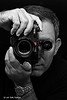
I met Jim Lee at the PhotoPlus Expo in New York City last October. Jim was demonstrating his invention, the BRNO baLens Lens Cap. This clever gadget combines a custom white balance tool with a lens cap. The practical offshoot of this combo is that you have one less bit of kit to have to haul around in your camera bag.
White balance refers to the color of the light being used to illuminate the subject. Even though the light may look white to our eyes, it may have a color cast to it ranging across the entire visible spectrum (and a little bit beyond depending on the camera used). The color of the light is referred to as the color temperature and is expressed as a numeric value in degrees Kelvin.
In the world of film, this is handled by the chemistry of the film used - daylight film for general use, tungsten film for studio lights, IR/UV film for special purposes.
In the digital world, a special sensor in the camera tries to determine the color of the light being used. Modern DSLRs have vastly improved Auto White Balance (AWB) sensors but they are not perfect and can be fooled by mixed lighting environments. Modern DSLRs also provide several preset white balance settings as well as a method to input color temperatures (in degrees Kelvin) directly or to take a custom measurement before shooting.
However, if one is shooting in RAW mode (and you should be), RAW conversion software will allow to make white balance corrections easily afterwards. The only time this does not work is if the target has no white/gray/black on them for the software to get a reading. In this case, one must take a custom white balance reading by using a white/gray card and taking a test shot.
So now we have two schools of thought on this matter:
* Shoot AWB and fix in post.
* Shoot with custom white balance and get it right in the camera (mostly).
On the surface, the "Fix it in post" school of thought seems to be the logical choice except in those cases where there is no white/gray/black to take a reading off of.
Or is it?
Lens Cap. This clever gadget combines a custom white balance tool with a lens cap. The practical offshoot of this combo is that you have one less bit of kit to have to haul around in your camera bag.
White balance refers to the color of the light being used to illuminate the subject. Even though the light may look white to our eyes, it may have a color cast to it ranging across the entire visible spectrum (and a little bit beyond depending on the camera used). The color of the light is referred to as the color temperature and is expressed as a numeric value in degrees Kelvin.
In the world of film, this is handled by the chemistry of the film used - daylight film for general use, tungsten film for studio lights, IR/UV film for special purposes.
In the digital world, a special sensor in the camera tries to determine the color of the light being used. Modern DSLRs have vastly improved Auto White Balance (AWB) sensors but they are not perfect and can be fooled by mixed lighting environments. Modern DSLRs also provide several preset white balance settings as well as a method to input color temperatures (in degrees Kelvin) directly or to take a custom measurement before shooting.
However, if one is shooting in RAW mode (and you should be), RAW conversion software will allow to make white balance corrections easily afterwards. The only time this does not work is if the target has no white/gray/black on them for the software to get a reading. In this case, one must take a custom white balance reading by using a white/gray card and taking a test shot.
So now we have two schools of thought on this matter:
* Shoot AWB and fix in post.
* Shoot with custom white balance and get it right in the camera (mostly).
On the surface, the "Fix it in post" school of thought seems to be the logical choice except in those cases where there is no white/gray/black to take a reading off of.
Or is it?
Above you see three photos. Actually, there are two photos, the middle photo is a copy of the left one.
Shot Specs:
* Nikon D300
* CV Nokton 58mm f/1.4 SL II lens
* 1/13s
* f/2.8
* ISO 1600
* Recorded as lossless compressed NEFs
* Illumination provided by two (2) Ikea Kvart reading lamps w/R-25 warm fluorescent bulbs
Post Processing
* Mac Pro 2.8 GHz w/12GB RAM used for post processing.
* Mac OS X Leopard 10.5.6
* Nvidia 8800GT + Dell WFP3007 30" Display
* Calibrated using Spyder3Studio
* Processed with Apple Aperture 2.1.2 64-bit
* Default Sharpening/NR
The photo on the left was shot using the D300's AWB sensor. The center photo is the same shot with WB adjusted in Aperture 2. The photo on the right was shot with a custom white balance calculated by pointing the camera with baLENS cap mounted on the lens directly at the light source and taking a reading. The image below shows you what the camera saw when it took the reading.
The following table summarizes the final white balance temperatures calculated by each method:
| Method | Temperature | Tint |
| Auto White Balance | 3099K | 8 |
| Post WB Adjust | 2954K | 27 |
| baLens Custom WB | 3024K | 20 |
* As you can see from the data, the D300's AWB sensor leaned towards the cooler temps with tint slightly favoring magenta.
* Adjusting the image in post using Aperture's WB selector tool yields temps about 150K warmer with tint more heavily leaning towards magenta - cooling the image overall.
* The baLens shot is only 75K warmer that the AWB shot, but it too, favored a heavier magenta tint cooling the overall image but not as much as Aperture did.
[EDITOR'S NOTE: The terms "cooler" and "warmer" can be a little confusing with regards to color temperature. "Cool" light tends to have more blue in it and thus has a higher color temperature - blue being physically hotter. "Warm" light leans towards the red end of the spectrum and has a lower color temperature - red-hot is cooler than blue-hot.]
So which method is best? That is entirely up to you and what you are trying to accomplish. Based on my little unscientific test above, the baLens will deliver a result that falls between the reading given by the camera's AWB sensor and the RAW converter's WB algorithms. Factors that can affect this result include: clouds, lens used, RAW converter used, and camera's AWB sensor. YMMV.
I found the output from the baLens to most closely resemble the scene I shot. I personally favor the cooler lighting of the Post AWB shot, but in this case the baLens shot was most accurate. For event photographers, that means dozens, if not hundreds of hours saved in front of the computer.
From a convenience standpoint, the BRNO baLens is brilliant. Snap it on instead of your regular lens cap and you never have to worry about bringing the white balance tool or the gray card again. The baLens ships with two inserts: the standard one used here and a warmer one if you prefer to shoot that way.
The BRNO baLens is available at the usual suspects (B&H, Adorama, etc...) and prices range from $44.95 - $64.95. Sizes range from 52-77mm. If you wish to purchase one or more, please support this site by clicking on the B&H link to the right and order from there.


 Posts
Posts